The first round of the NBA Draft went to form in the early stages, but it wasn’t long before the deals started going down
The first round of the 2026 NBA Draft is locked in. Whew. Take a breath. Chalk reigned supreme throughout the lottery with the Washington selecting BYU’s AJ Dybantsa, Utah snagging Kansas’ Darryn Peterson, Memphis targeting Duke’s Cameron Boozer and Chicago flying up to the podium to announce that UNC’s Caleb Wilson was its man.
But it didn’t stop there.
The point guards came off the board in a flurry. The much-debated quartet of Keaton Wagler, Mikel Brown Jr., Darius Acuff and Kingston Flemings went back-to-back-to-back-to-back before it became the Michigan Invitational.
Dusty May and the defending champions were well-represented. Who says you can’t find pros in the portal? May will reunite with Morez Johnson in Dallas, Yaxel Lendeborg is off to ball out with Steph Curry and Draymond Green in Golden State and Oklahoma City landed its potential Wemby Stopper in 7-foot-3 mountain, Aday Mara.
The second round of the draft is scheduled for Wednesday at 8 p.m. ET at the Barclays Center in Brooklyn, New York.
Worth the hype
One reason to potentially explain the fact that there were no non-Giannis-adjacent trades in the first 15 picks? The talent was too good! Every team that earned the right to pick in the lottery chose to hold serve and take the best player available. Sure, there was pre-draft sniffing around, but the decision-making from front offices paints the picture that this presumed historic draft could live up to the hype because so few teams were willing to trade back.
Spurs buff up
San Antonio may have the alien in Victor Wembanyama, but it found itself a bit too small for long sequences. The Spurs’ braintrust clearly attacked Tuesday’s first round with that in mind, selecting Kentucky’s Jayden Quaintance at No. 20 and trading up to No. 26 to snag UConn big fella Tarris Reed. Quaintance is arguably the best defensive prospect in this entire draft. He owns a 7-foot-5 wingspan and did some jaw-dropping stuff defensively when healthy at Arizona State. If Quaintance can get fully healthy after a setback following a torn ACL, the Spurs’ already-intimidating interior defense can level up. The idea that San Antonio drafted the highest-upside defender to pair with the reigning unanimous Defensive Player of the Year is sick, sick stuff.
But if Quaintance needs a long runway to return, that opens the door for Reed to be a ready-to-play role player. San Antonio needed more defensive rebounding, and Reed is an elite board maven. His physicality will help the Spurs immensely.
Market miscalculation
Arkansas’ shot-maker Meleek Thomas, UNC big man Henri Veesaar and Duke’s sharpshooter Isaiah Evans will all be among the best available players for Wednesday’s second round.
They all had the option to return to the college ranks for serious money.
Big men of Veesaar’s ilk would have been worth a pretty penny in the transfer portal (think all of $5 million), but he chose to keep his name in the draft. Meleek Thomas had a star role with his name on it if he chose to return to Arkansas. Duke was not expecting Evans back, which is why they chased top-rated Wisconsin transfer John Blackwell and retained Cayden Boozer and Caleb Foster, but it’s clear that Evans left money on the table by staying in the NBA Draft compared to returning to college for his junior season.
Arizona big man Koa Peat would’ve been in the same boat, but Phoenix flew into the No. 30 slot to snag Peat with the final pick of the first round.
In the short-term, Thomas, Veesaar and Evans would have made more money playing in college basketball next season, but the questions that crept up in the pre-draft process were hard to ignore. Teams certainly questioned Veesaar’s toughness. There were concerns about Thomas’ ability to impact the game when he’s not making shots. Evans earned a green room invitation, signaling legit first-round interest, but there was smoke about a dip well before Tuesday’s first round.
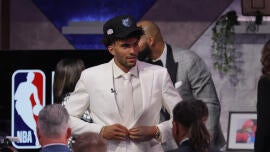
And now we wait to see if the long-term bets from Veesaar, Thomas and Evans will be profitable.
Suns take Koa Peat
No. 30: Peat to Phoenix (via trade with Dallas)

Peat is a relentlessly physical forward whose stock is hindered by a 3-point shot that was MIA during his lone college season at Arizona. That contributed to Peat’s significant pre-draft fall. But Peat will be able to hold his own against nearly anyone defensively from day one. If the outside shot comes along, Peat will be an NBA starter. This is a smart swing at No. 30 for the Suns, who reportedly traded with Dallas to get the pick.
Kings take Alex Karaban
No. 29: Karaban to Sacramento (via trade with Cleveland)

Sacramento is signaling its belief in Alex Karaban by trading up from No. 34 to snag him in a deal with Cleveland. Karaban is a stretch four with a quick release who could help keep the floor spaced as Darius Acuff gets to work. Karaban comes from a winning culture at UConn, where he spent 4.5 seasons. There will be concerns about his defensive versatility at the NBA level.
Nets take Joshua Jefferson
No. 28: Jefferson to Brooklyn

Jefferson is one of the top processors in this draft. The 6-foot-9 burly forward is pound-for-pound as good a passer as anybody, and Jefferson’s jumper has improved every single season. Jefferson isn’t some jump-off-the-tape athlete, but the basketball IQ, playmaking and defense form a connective tissue that all good teams have. Jefferson won at Saint Mary’s and won at Iowa State and will likely contribute to winning in Brooklyn.
Evaluating what Boston is getting in Chris Cenac Jr.
Celtics take Chris Cenac Jr.
No. 27: Cenac to Boston

The functionality of his game is still a work in progress, but Cenac’s 7-foot-5 wingspan catches the eye, and a franchise with the appetite to develop him could wind up getting a good return on its investment. There were enough flashes of a 3-point shot at Houston (33.3% in his lone season) to believe in a positive long-term outcome. The physical tools are certainly there.
What San Antonio is getting in Tarris Reed Jr.
Spurs take Tarris Reed Jr.
No. 26: Reed to San Antonio (via trade with Denver)

Bigs are back in the NBA — at least to a certain extent — and that’s good news for Reed, who measured just a fraction under 6-foot-10 without shoes at the combine. Throw in a wingspan of longer than 7-foot-4 with a feathery interior touch and you get a player who is worth a shot. Reed doesn’t have All-Star potential, and the Spurs have already added Jayden Quaintance to their front court tonight. So a role might be tough to find.
Per ESPN’s Shams Charania: “Denver is trading No. 26 to the San Antonio Spurs for No. 35 and two future second round picks, sources said.”
Mavericks take Sergio De Larrea
No. 25: De Larrea to Dallas (via trades with Lakers/Knicks)

De Larrea is coming off the board earlier than expected, but there’s a lot to like. He’s been playing professionally in Spain and has logged significant action for Valencia this season at the highest levels of the game in Europe. He’s developed a reputation for being a great shooter — he’s shooting 39.2% from deep this season — and he’s got good size for a lead guard.
Lakers take Cameron Carr
No. 24: Cameron Carr to Los Angeles (via trade with Knicks)

Carr averaged 18.9 points at Baylor while filling it up efficiently and in a variety of ways. His nearly 7-1 wingspan exceeds that of both AJ Dybantsa and Caleb Wilson. Throw in the second-best standing vertical leap of anyone at the combine and you get a rare combination of skill and tools that makes Carr a high-upside pick for the Lakers. This was a great pick by Los Angeles. It’s rare that you can find someone with Carr’s amount of upside at this point in the first round.
Hawks take Zuby Ejiofor
No. 23: Zuby Ejiofor to Atlanta

Zuby Ejiofor is a small-ball five with a versatile defensive skill set and a growing offensive profile. As a senior at St. John’s, he grew as a facilitator and showed more flashes of a perimeter shot. If nothing else, he’ll help beef up the Atlanta front court. Ejiofor’s energy and toughness will make him a hassle to deal with in the NBA.
Labaron Philon’s slide
76ers take Labaron Philon

No. 22: Labaron Philon to Philadelphia
Philon slithers to his spots at will, and there’s not much you can do to stop it. The Alabama guard showed vast improvement with his pull-up jumper and proved he can get buckets in his sleep. He was one of the most dangerous isolation bucket-getters in all of college basketball last season, making even the most mobile defensive bigs so uncomfortable with his barrage of in-and-out dribbles to set up a stepback J or a knockdown floater. The challenge will be finding ways to blend all the delightful role-player traits that he showcased as a freshman back into his game. Philon has more in the tank defensively. He has more in the tank as a connect-the-dots role player who can smash advantages created by a true alpha guard.
Grizzlies take Karim Lopez
No. 21: Karim Lopez to Memphis (via trade with Detroit)

As if Memphis hadn’t already picked up enough toughness with Cam Boozer at No. 3, it just added even more with Karim Lopez. He profiles as a physical glue guy who could develop into something more if his 3-point shot comes in. For now, he’s adept at putting his head down and getting to the lane off of catches on the wing. If nothing else, he’ll be useful defensively and on the glass and slot in as a down ballot offensive option.
Spurs take Jayden Quaintance
No. 20: Jayden Quaintance to San Antonio
A knee injury limited Quaintance to just 28 games over two college seasons, but he showed tantalizing upside as a rim protector during his freshman season at Arizona State. Only two players in this draft — Aday Mara and Luigi Suigo — registered better wingspans at the combine. He will help reinforce the front line in San Antonio, giving the Spurs a great rim protector to bring off the bench behind Victor Wembanyama.
Raptors take Allen Graves
No. 19: Allen Graves to Toronto

After doing a little bit of everything for an NCAA Tournament team at Santa Clara, Graves is this year’s NBA Draft analytics darling. Good size? Check. Impactful defender? Check. Proficient 3-point shooter? Yes (41.3%). Does he rebound? Yes. He’ll need to show he’s got the athleticism to chase NBA forwards around, but the building blocks of a solid player are in place.
Hornets take Christian Anderson
No. 18: Christian Anderson to Charlotte

The first thing any scout will note on Anderson is that he’s undersized. But once you get past that obvious truth and dive into the game, there is a lot to like. He’s a good athlete, a great 3-point shooter (both off the dribble and off the catch) and an elite facilitator. Sometimes the eye test is worth more than the measuring tape, and that could prove to be true with Anderson.
Pistons take Ebuka Okorie
No. 17 Ebuka Okorie to Detroit (via trade with OKC/Memphis)

Ebuka Okorie was the No. 119 ranked prospect in the Class of 2025. But he turned out to be one of the best scorers within an absolutely loaded freshman class. Though undersized, Okorie has both elite feel for the game and explosive quickness. Pegging him as a sure thing is a bridge too far, though. In fact, this is a risky play by Detroit to be so aggressive in pursuing Okorie when both Christian Anderson and Labaron Philon were still on the board. The Grizzlies have racked up five second-round picks while moving back from 16th to 21st, according to ESPN.
Thunder take a swing
Bennett Stirtz | 6-3 | 190 | PG
Oklahoma City is taking a swing by picking Bennett Stirtz at No. 16. OKC is passing on sophomore studs Christian Anderson (Texas Tech) and Labaron Philon (Alabama) to take a former Division II guy who rose to prominence with Drake and Iowa over the past two seasons. Stirtz will likely have to reinvent himself to a certain degree in order to carve out a long NBA career after he was a pick-and-roll maestro in a slow-paced college system under Ben McCollum. But he’s proven himself at the Division II, mid-major and high-major levels. If he can hold up defensively in the NBA, he could find rotation minutes as a flame-throwing floor general.
Thunder take Bennett Stirtz
No. 16: Bennett Stirtz to Oklahoma City (via trade with Memphis)

Do you make everyone’s life easier? That’s a question GMs don’t have to ponder long with Stirtz. The Iowa product has the combination of shooting (92 3s at a 36% clip), ball movement and cutting that is attractive. Stirtz will have to adjust to playing more off the ball after spamming pick-and-rolls left and right under Ben McCollum, but he’s sharp enough to figure out the counters. It’s still impressive that a Division II product like this can become a first-round pick.
Chicago gets a second rim attacker
Dailyn Swain | 6-7 | 211
Swain is a true utility player who can fit in a variety of systems and with a variety of personnel. He took significant strides as a 3-point shooter at Texas this season, but his strength lies in his ability to reach the rim. Between Swain at No. 15 and Caleb Wilson at No. 4, Chicago has acquired a couple of big forwards who are adept at getting into the paint.
Bulls take Dailyn Swain
No. 15: Dailyn Swain to Chicago

Swain is a slippery, creative driver with a plethora of counters in his bag to get to the cup. Nearly 60% of his shots this past season at Texas came at the rim, and Swain shot a promising 63% at the rim, per Synergy. Swain doubles as one of the better passing wings in this class, and it’s easy to see him scaling down to fill a role. Swain was a defense-first option at Xavier before turning into a primary fulcrum at Texas. If defense is what’s required to carve out minutes, Swain will be able to buy into that. The jumper may not ever be a major strength, but Swain’s jumbo creation is hard to pass up.
The lottery concludes with Steinbach
Hannes Steinbach | 6-10 | 248 | PF/C
As an international prospect who toiled in relative anonymity for a 16-17 Washington team in his only college season, Steinbach is easily overlooked. Don’t fall into the trap. He’s a double-double machine with elite hands who can stretch the floor and convert at the free-throw line. The combination of skill and size in a still-developing package makes a lot of sense for Charlotte.
Hornets take Hannes Steinbach
No. 14: Steinbach to Charlotte
Steinbach is a tractor-trailer just barreling down the paint. He’s right up there with Houston’s Chris Cenac, Arizona’s Tobe Awaka and Duke’s Cameron Boozer as the top rebounder in this entire class. Steinbach doesn’t just have good hands. He has great paws. He catches anything and everything. That should earn him some grace with any coaching staff because he will help ’em win the shot-volume game. Steinbach has some holes in his game. He’s not a great defender in space and he’s a limited rim protector, but the interior finishing and rebounding is so valuable.
Leave a Reply
You must be logged in to post a comment.