Walker is the first Cardinals player in franchise history to win the Home Run Derby
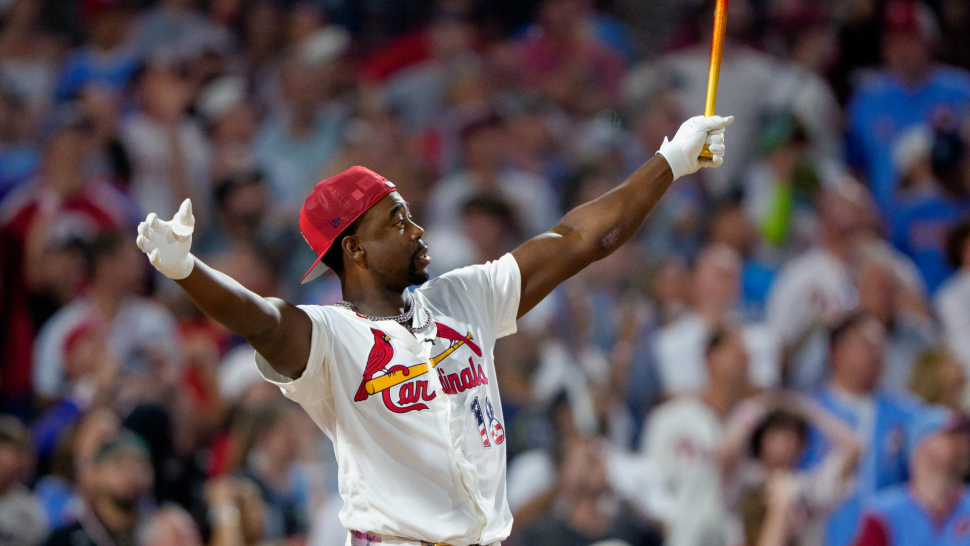
Thanks to one of the best Home Run Derby finishes ever, Cardinals slugger Jordan Walker rallied to upset Phillies star Kyle Schwarber in the 2026 Derby at Citizens Bank Park in Philadelphia. Walker hit six home runs on his final six swings, including four with the “final ball” to come back and beat Schwarber, stunning the decidedly pro-Schwarber crowd.
The final tally was 12-11 in the final round. Here is Walker’s final swing to win it:
“I was once told you don’t boo nobodies,” Walker said on the Netflix broadcast after hearing loud boos throughout his final round (and loud cheers whenever he made an out).
Walker is the first Cardinals player to win the Home Run Derby. He denied Schwarber the chance to become the fourth player to win the Derby in his home ballpark. Bryce Harper (2018 at Nationals Park), Todd Frazier (2015 at Great American Ball Park), and Ryne Sandberg (1990 at Wrigley Field) are still the only three men to win the Home Run Derby at home.
As the Derby winner, Walker banked $1 million in prize money (more than the $799,400 he’s set to earn this year). Schwarber takes home $500,000 as the runner-up. The other six players received $150,000 each. Here now are the final home run totals and our takeaways from the 2016 Home Run Derby.
2026 Home Run Derby bracket, results
First round
- Willson Contreras: 13 (longest: 490 feet)
- Jordan Walker: 13 (longest: 470 feet)
- Junior Caminero: 12 (longest: 487 feet)
- Kyle Schwarber: 10 (longest: 461 feet)
—————————————————————————- - Munetaka Murakami: 9 (longest: 466 feet) (eliminated)
- Bryce Harper: 8 (longest: 482 feet (eliminated)
- Jac Caglianone: 8 (longest: 477 feet) (eliminated)
- Ben Rice: 7 (longest: 443 feet) (eliminated)
MLB dumped the clock this year and went to a swing-based format. Players were given 20 swings in the first round and, on the “final ball,” they could continue swinging as long as they hit a home run. The top four home run totals advanced to the second round, and any ties would have been broken by the longest home run distance.
Semifinals
After the first round, the four semifinalists were paired up in a 1 vs. 4 and 2 vs. 3 head-to-head bracket based on their first-round home run totals. Here are the results:
No. 1 Willson Contreras: 8 HR (eliminated)
No. 4 Kyle Schwarber: 9 HR
No. 2 Jordan Walker: 6 HR
No. 3 Junior Caminero: 5 HR (eliminated)
Players were given 15 swings in the semifinals, not 20, and they could again continue swinging on the “final ball” as long as they hit a home run. If there had been a tie, there would have been a three-swing swing-off.
Finals
The finals are simple. Most homers win. Schwarber went first and had the Philly crowd buzzing with 11 home runs. Walker then stepped in, hit only eight homers on his 13 swings, then rattled off six straight homers (four with the “final ball”) to come back and win the Home Run Derby. It was as dramatic a finish as we’ve ever seen in this event.
The new format is good
I was concerned the new swing-based format would turn the Home Run Derby into the Take Pitches Derby, but that wasn’t the case. The pace was good throughout. Also, no more clock meant home runs had a chance to breathe. We could watch and enjoy them all without being rushed into the next swing. No clock meant we could fully enjoy Jac Caglianone visiting the upper deck:
I expected more upper deck shots, but only Caglianone went up there, and he did it on back-to-back swings. For sure, though, the new format is very good. Good pace and it makes for a better broadcast. Thumbs up 👍.
Contreras played the villain
He leaned into it, too. It’s Philadelphia, so every player except Harper and Schwarber was booed during the introductions, but only Contreras egged on the crowd. He did so again before his first round, which was very impressive. Contreras set the bar high as the first batter of this year’s Home Run Derby. He hit 13 homers in the first round, including four of the night’s eight longest dingers.
Contreras was matched up with Schwarber in the semifinals and the Philly crowd let him hear it. He was booed constantly during his round and every swing that didn’t result in a home run was cheered. Sure enough, it came down to the final swing. Schwarber hit nine homers. Contreras had eight with one swing left. When he popped up on his final swing, the Citizens Bank Park crowd erupted like the Phillies won the World Series. Check it out:
Contreras played a great heel. He had fun with the crowd and smiled at the boos.
Caminero hit the night’s longest homer
Caminero, last year’s Home Run Derby runner-up to Cal Raleigh, has hit 50 home runs since last year’s All-Star break, second most in baseball behind Schwarber’s 58. Caminero had this year’s Home Run Derby’s longest homer, a 492-foot shot in the semifinals:
Hitting the night’s longest homer earned Caminero an additional $100,000 in prize money. He also had the two hardest hit balls of the night, two 116 mph exit velocities in the first round. Caminero only hit five home runs in the semifinals, which was a bit underwhelming, though he certainly clobbered some of the night’s most majestic blasts.
It was Phillie vs. Phillie in the first round
Schwarber and Harper, the two hometown Phillies, were the last two batters to hit in the first round. Once Schwarber hit 10 and bumped Murakami out of the semifinals, it guaranteed a Phillie would advance. Which one? The only way Schwarber could be eliminated was if Harper eliminated him. So, it was Phillie vs. Phillie for the last semifinals spot.
Harper clinched the tiebreaker over Schwarber with a 482-foot blast, but he ultimate fell two homers short of advancing. Here is that 482-foot homer, which cleared the second deck and landed on Ashburn Alley:
Harper and Schwarber have faced off in the Home Run Derby before. This wasn’t quite as dramatic as the 2018 finals, when Harper edged out Schwarber 19-18 at Nationals Park, but it was still a fun moment for the hometown crowd.
Leave a Reply
You must be logged in to post a comment.